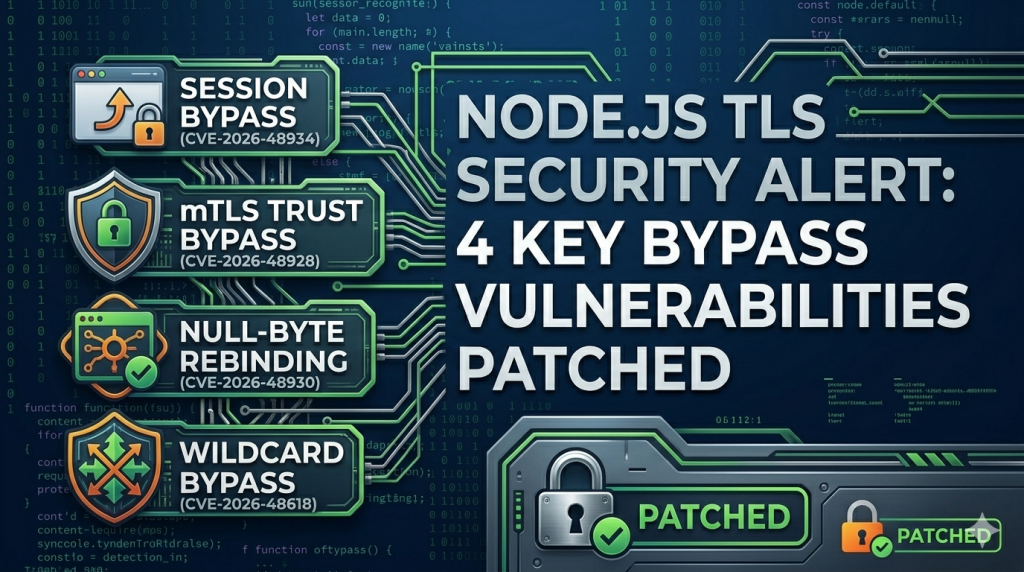
In modern server-side architecture, Transport Layer Security (TLS) and mutual TLS (mTLS) serve as the bedrock of secure communications. When cryptographic validation fails or can be systematically bypassed, the entire security posture of an ecosystem collapses.
The Node.js Project recently shipped its June 2026 Security Release, addressing a cluster of high-severity vulnerabilities impacting core TLS, DNS, and authentication subsystems across all active release lines (Node.js 22, 24, and 26).
This article deconstructs the mechanics of four specific vulnerabilities that allow attackers to break trust boundaries, hijack identities, and execute authentication bypasses.
1. CVE-2026-48934: Certificate Validation Bypass via Reusable Sessions
Severity: Critical / High
Impacted Subsystem:
tlsThe Core Issue: Reusable TLS session binding failure.
Node.js
The Mechanics
TLS session resumption is a performance optimization that allows a client and server to reuse previously established cryptographic keys, skipping the expensive asymmetric key exchange during a reconnect.
In affected Node.js versions, a flaw in the TLS host verification logic allowed reusable sessions to be decoupled from the authenticated host. When a client attempted to resume a session, Node.js failed to strictly re-verify that the session context tightly matched the newly requested host’s certificate validation constraints. An attacker capable of performing a Man-in-the-Middle (MitM) attack or manipulating session caching could reuse a valid session token meant for one host to complete a handshake with a completely different, unauthenticated host, effectively bypassing full certificate validation.
The Fix
The patch ensures that reused or cached TLS sessions are explicitly bound to the authenticated host identity, preventing cross-host session hijacking.
2. CVE-2026-48928: mTLS Trust-Policy Bypass in Multi-Context Setups
Severity: High
Impacted Subsystem:
tls(SNI Context Matching)The Core Issue: Case-sensitivity mismatch in Server Name Indication (SNI).
support.cpanel.net. – cPanel
The Mechanics
Mutual TLS (mTLS) requires both the client and the server to present certificates. In multi-tenant or multi-domain environments, Node.js applications frequently use SNI (Server Name Indication) to dynamically swap TLS contexts (including trusted Client Certificate Authorities) based on the hostname requested by the client.
CVE-2026-48928 exposes an inconsistency in how Node.js matches incoming hostnames against configured SNI contexts. Specifically, the matching algorithm handled case sensitivity incorrectly.
The Attack Scenario: If an application defined a strict mTLS trust policy for
secure.api.example.com, an attacker sending an SNI request with a casing variant (e.g.,Secure.API.Example.com) could cause Node.js to fail its primary context lookup. Instead of rejecting the request, it fell back to a default or weaker context, bypassing the intended strict client-certificate trust policy entirely.Node.js
The Fix
The implementation was refactored to enforce case-insensitive hostname normalization prior to performing SNI context routing.
3. CVE-2026-48930: Authority Rebinding due to C-String Truncation
Severity: Medium / High
SiembiotImpacted Subsystem:
dns,netThe Core Issue: Improper handling of embedded null (
\0) bytes in hostnames.
The Mechanics
Node.js sits on top of a hybrid architecture: high-level logic runs in JavaScript, while low-level networking and DNS functions rely on native C/C++ libraries (like c-ares or system resolver bindings).
JavaScript strings can natively contain null bytes (\0) without any operational issue. However, standard C-strings interpret the null byte as a string terminator. CVE-2026-48930 highlights a classic mismatch: when a hostname containing an embedded null byte (e.g., target.internal\0.attacker.com) was fed into the network stack, the JavaScript layer treated it as a single string, but the native underlying C-bindings truncated it immediately at the \0.
This lead to a silent authority rebinding:
The application believes it is routing traffic or applying security boundaries to
target.internal\0.attacker.com.The low-level resolver strips the suffix and initiates a connection directly to
target.internal.
Attackers could leverage this architectural discrepancy to smuggle requests past security filters or force internal routing mismatches.
The Fix
Node.js now explicitly validates all hostnames within the dns and net modules, rejecting any string containing embedded null bytes before they reach native layers.
4. CVE-2026-48618: Wildcard-Depth Authentication Bypass
Severity: High
Impacted Subsystem:
tls(Verifier/Resolver Mismatch)The Core Issue: Unicode dot separator normalization flaws.
The Mechanics
Wildcard certificates (e.g., *.example.com) are restricted by RFC standards to a single level of depth; sub.example.com matches, but deep.sub.example.com should not.
CVE-2026-48618 stems from an interpretation conflict regarding Unicode dot separators (such as . U+FF0E or . U+002E) during hostname normalization. When evaluating wildcard certificate compliance, the certificate verifier and the network address resolver handled these alternative dot characters differently.
An attacker could craft a certificate or request hostname utilizing specific Unicode dot variants. The resolver normalized the characters to standard periods to route the traffic, while the wildcard verification depth logic failed to parse the nested structure correctly due to the alternate encoding. This normalization mismatch allowed an attacker to trick Node.js into validating a wildcard certificate far beyond its permitted depth boundary.
The Fix
The update unifies how both the hostname verifier and resolver normalize Unicode string inputs, eliminating structural interpretation disparities.
Remediation Roadmap
To secure your infrastructure against these bypass vectors, immediate upgrades are required.
| Current Release Line | Minimum Secure Version |
|---|---|
| Node.js 22 (LTS) | v22.23.0 |
| Node.js 24 (LTS) | v24.17.0 |
| Node.js 26 (Current) | v26.3.1 |